
SE – Understanding Empathy Under Pressure
Sustainable empathy is not the absence of emotional impact.
It is the capacity to recognise, regulate and recover from that impact so that caring remains a source of meaningful connection rather than a pathway to depletion.
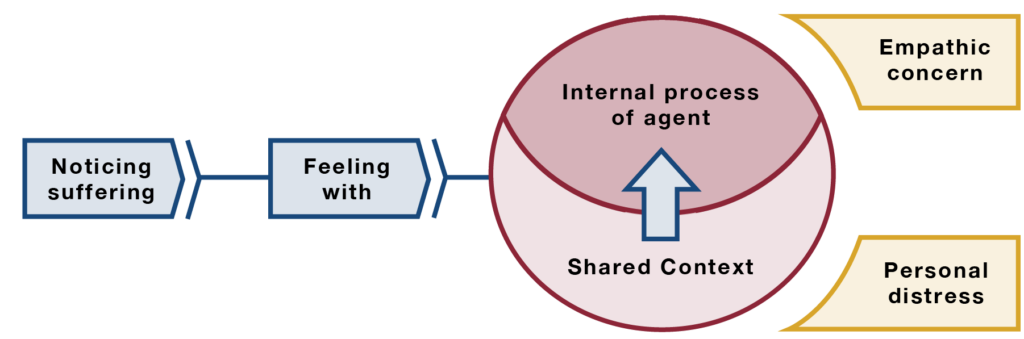
Instead of experiencing:
“I can see that you are suffering and I am here with you,”
The internal experience may become:
“This is too much. I cannot bear what I am feeling.”
You may then unconsciously attempt to escape the discomfort.
You may experience:
- Withdraw emotionally,
- Become impatient,
- Rush to solve the problem,
- Become overly controlling, or
- Shut down.
These responses are not evidence that you lack empathy or compassion. They may instead indicate that your capacity to regulate the emotional demands of caring have been exceeded.
Caring under sustained pressure can gradually deplete your emotional and physiological resources.
Sustainable empathy requires recognising early strain, regulating emotional resonance, maintaining self-other boundaries, and creating supportive organisational conditions that enable professionals to remain open, effective and compassionate.
The Invisible Labour of Caring
Much of the work involved in caring for others is invisible. Helping professionals do not simply listen to information. They continuously interpret verbal and non-verbal signals, sense emotional states, anticipate needs and adjust their responses. They may absorb tension in a room, remain calm in the presence of distress, contain strong emotions and provide reassurance even when they themselves feel uncertain or pressured. This requires emotional and physical effort.
Over time, the repeated activation of empathic and regulatory processes can place strain on the individual. The professional may continue to perform competently, while internally becoming increasingly depleted. Hence, the early stages of empathic strain are often overlooked. Professionals may not immediately experience a dramatic breakdown. Instead, the cost accumulates gradually.
When Empathy Becomes a Burden
Video: Understanding empathic strain, compassion fatigue and burnout
Empathy is meant to connect us — but under sustained pressure, it can become a burden we carry alone. In this video, we explore how empathic strain, personal distress, burnout, and secondary traumatic stress differ, and why naming these experiences accurately is the first step toward sustaining our capacity to care.
Watch now to start building the language and awareness you need to recognise these patterns in yourself and your practice.
The Cost of Caring in High Demand Systems
High-demand caring professions place sustained emotional, cognitive and physiological demands on those who support others. While pressure is an inevitable part of caring work, prolonged exposure to distress, suffering and crisis can gradually erode a professional’s capacity to remain emotionally present and effective.
The progression often begins with pressure, particularly when demands exceed available resources, recovery and support. This can lead to empathic strain – the cumulative impact of sustained emotional engagement, characterised by emotional overload, difficulty switching off, bodily tension and reduced capacity to maintain healthy boundaries between self and other.
When empathic strain remains unrecognised or unsupported, it may contribute to compassion fatigue, where emotional depletion begins to affect patience, connection and the capacity to sustain compassionate engagement. From there, different pathways may emerge. Chronic workplace and organisational stress can contribute to burnout, marked by exhaustion, cynicism and reduced effectiveness. Repeated exposure to the traumatic experiences of others may contribute to secondary traumatic stress, including intrusive thoughts, hyperarousal, avoidance and emotional numbing.
The central premise of Sustained Empathy Under Pressure is that empathic strain represents an important early intervention point. By recognising and responding to strain early, professionals and organisations can protect their capacity to care before more serious forms of depletion develop.
Pressure becomes harmful when it cannot be processed, regulated and renewed. Sustainable empathy develops the capacity to notice strain early and remain connected without becoming depleted.
The Five-Point Logic
1. Pressure
High-demand caring environments can expose professionals to sustained emotional, cognitive and physiological demands. Pressure may include workload, responsibility, conflict, suffering, crisis and, in some contexts, repeated exposure to trauma.
↓
When demands exceed available resources
2. Empathic Strain
The cumulative emotional and physiological impact of sustained empathic engagement begins to emerge. Professionals may experience emotional overload, difficulty switching off, bodily tension, reduced self-other differentiation and diminished recovery.
↓
When strain remains unrecognised or unsupported
3. Compassion Fatigue
The capacity to sustain compassionate engagement begins to erode. Professionals may become emotionally depleted, detached, impatient or less able to connect with the people they serve.
↓
Prolonged exposure can contribute to different outcomes
4. Burnout
Where chronic organisational and occupational demands remain unmanaged, exhaustion may develop into burnout, characterised by emotional exhaustion, cynicism or mental distance, and reduced professional effectiveness.
5. Secondary Traumatic Stress
Where empathic work involves repeated exposure to other people’s trauma, strain may also develop into secondary traumatic stress, including trauma-related symptoms such as intrusive thoughts, hyper-arousal, avoidance and emotional numbing.
Key Learning
- Caring can have a cumulative cost.
Sustained exposure to the needs, distress and suffering of others places emotional, cognitive and physiological demands on you.- Pressure is not necessarily harmful – but sustained pressure without adequate resources is.
The risk increases when emotional demands consistently exceed opportunities for support, regulation and recovery.- Empathy can become a source of strain when emotional resonance is unregulated.
Automatic affective resonance may lead you to absorb distress, over-identify with others or carry emotional burdens beyond the encounter.- Empathic strain is an important early warning signal.
Emotional overload, bodily tension, difficulty switching off, reduced patience and boundary erosion may indicate that caring demands are accumulating.- Compassion fatigue reflects an erosion of the capacity to sustain caring engagement.
It may appear as emotional depletion, detachment, reduced patience and difficulty remaining compassionately present.- Burnout and secondary traumatic stress are related but distinct risks.
Burnout is primarily associated with chronic occupational and organisational stress, while secondary traumatic stress may result from repeated indirect exposure to the trauma of others.- Early recognition creates an opportunity for prevention.
By noticing empathic strain before it progresses, you can intervene through self-awareness, regulation, support, boundaries and recovery.- Sustainable empathy is not about caring less – it is about caring differently.
The goal is to remain emotionally open and responsive without becoming overwhelmed: recognising the impact of caring, regulating empathic responses and renewing the capacity to remain present under pressure.
I