
Self-empathy: The Building Blocks
Self-empathy is the act of noticing and recognising what is happening in you while carving an inner attentional space for others. In Self-empathy: The Building Blocks we describe when and why to use self-empathy and how it prepares a foundation for you to empathize with others.
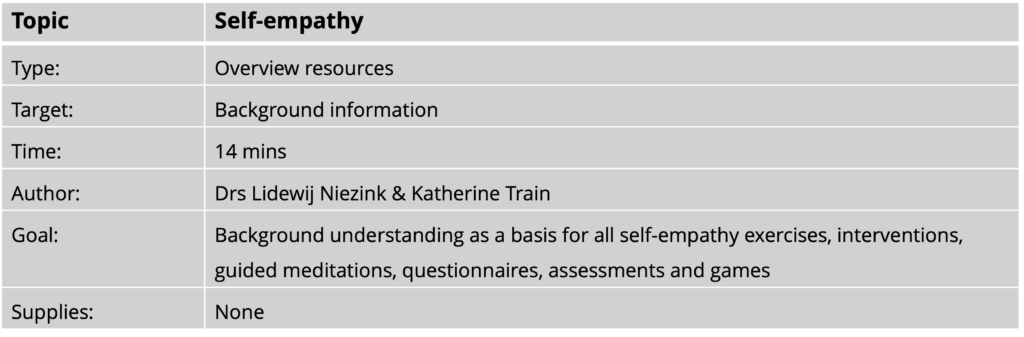
Background
Read more about self-empathy in our series of articles in Psychology Today.
The Self in Empathy: Self-empathy When you feel challenged and misunderstood, empathizing with someone else is difficult. That’s why the first step is to empathize with yourself.
Noticing with Self-empathy Do you find yourself getting caught up in interactions where misunderstandings are starting to occur, making you feel threatened and defensive? Self-empathy helps you to notice.
Self-empathy with ethical responsibility and centredness Working with others to provide an encouraging presence or healing space requires providing a conducive environment for them. Self-empathy helps create that presence and space.
Preventing Conflict With Self-empathy Self-empathy helps us navigate polarizing assumptions and judgments.
The Light and Dark Side of Empathy Empathy is neutral; it can be used for good or to harm or manipulate. Where do your motivations and intentions to empathize come from?
Self-empathy is required to empathize with others. When you empathize with others, how do you know that it’s not just a projection of your own experiences?
Take a look at our range of interventions, exercises and meditations for you to use, for yourself and with your clients:
Self-empathy: Guided Meditation
Self-empathy: Practice in dyads
Tool Description
How Self-empathy is Useful
Imagine you have arrived at a meeting in a bad mood. Your colleague reprimanded you the previous day which left you with a feeling of negativity towards her. The negativity spilled over into the whole group. When becoming aware of, sensing and naming the feeling, and suspending any judgment that may arise towards it, you might realize that you generalized a small incident towards the whole team. This insight might lead you to set a personal intention to bring a more positive attitude towards the group process.
What is Self-empathy: Summary of Key Points
- Self-empathy is the act of noticing and recognising what is happening in us and working with it to create an inner space for others.
- Self-empathy means that we observe, in an empathic manner, our own experiences.
- When we experience strong feelings, i.e. we feel challenged, euphoric or misunderstood, self-empathy allows us to empathically notice our own thoughts, feelings and behaviours.
- Self-empathy helps us develop agency: An awareness of ourself as being the initiator of actions, desires, thoughts and feelings.
- Self-empathy is a prerequisite for empathy with others.
- Empathizing with others requires presence and an attitude of unconditional positive regard.
Video: Self-empathy: The Building Blocks
In this video we introduce you to the four self-empathy building blocks in Integrative Empathy.
The Building Blocks: Summary of Key Points
The four building blocks of self-empathy are to:
- Arrive: to draw your attention away from outer events, people and things and to attend to your own inner world of thoughts, feelings and experiences.
- Sense and make sense: With sensing we notice our thoughts, feelings and experiences and then we make sense of what we notice by recognizing and naming the dimensions of our lived experience.
- Suspend judgment: For the time being, we lay aside our own views and values in order to enter the inner and outer world without prejudice and preconception.
- Set and invoke intention (more about this in Self-empathy: Set personal intentions).