

From Self to System:
Relational Resilience and the Alchemy of Presence
In many professional environments resilience is still framed as an individual capacity: the ability to cope, endure, and keep going under pressure. Yet this framing is increasingly insufficient. Burnout, relational breakdown, and systemic strain point to a deeper truth: resilience is not only personal, it is relational. It lives in the quality of connection we are able to sustain – with ourselves, with others, and within the systems we are part of.
The Heart of Relational Resilience
At the heart of relational resilience lies a subtle but powerful human experience: the moment connection shifts. Most people recognise it. You begin present, open, and engaged with another person. Then something changes: a tone, a comment, or even an internal association and the connection collapses. You find yourself no longer with the other, but inside your own reactions: defending, judging, withdrawing, or shutting down.
From Presence to Absence and Back Again
Otto Scharmer describes this movement as a shift from presencing to absencing. In a state of presencing, we are open, attuned, and responsive to what is emerging in the moment. In absencing, we become trapped in habitual patterns shaped by past experience. Our perception narrows, and our capacity to relate diminishes.
Understanding this shift is key to developing relational resilience. Absencing is not a failure; it is a natural, embodied response to perceived threat or discomfort. It is often driven by what Scharmer calls the three “voices of resistance”: the Voice of Judgment, which closes the mind through over-analysis; the Voice of Cynicism, which closes the heart through emotional distancing; and the Voice of Fear, which closes the will through anxiety or avoidance. These voices can arise quickly and subtly, often before we are consciously aware of them.
What makes relational resilience possible is the ability to recognise these micro-moments as they arise, and to work with them rather than be overtaken by them.
Relational Presence to Remain Aware and Connected
This is where the concept of relational presence becomes essential. Relational presence is not the absence of reaction, but the capacity to remain aware and connected within it. It is the ability to notice, “something in me is tightening,” without immediately acting from that contraction. It creates a space between stimulus and response, where choice becomes possible.
Developing this capacity requires a shift from passive to active sensing of our bodily responses. Passive sensing is when we are immersed in our reactions without awareness. Active sensing, by contrast, involves turning attention toward the body and its signals and bringing them into conscious awareness: tuning in to breath, tension, posture and gesture and impulse. Body-based practices support this process by helping individuals engage directly with their lived, embodied experience, rather than only with thoughts about it.
Through this kind of awareness, the very reactions that pull us out of connection can become sources of information.
A tightening in the chest may signal a boundary being crossed; a surge of irritation may point to an unmet need or value. When met with curiosity rather than suppression, these responses become guides rather than obstacles.
An “opening process” into lived experience offers a further pathway for moving from absencing back into presence. This involves three key gestures: suspending habitual judgments, redirecting attention inward to one’s own experience, and letting go of fixed expectations or outcomes . Together, these shifts create the conditions for a more responsive, less reactive way of engaging with others.
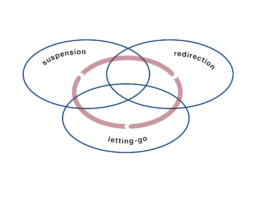
Stages of the “Opening Process”
Note. With input from The phenomenological mind by S. Gallagher and D. Zahavi, 2008, New York: Routledge
Relational Resilience within Tension, Difference or Misunderstanding
Relational resilience expands beyond the individual into the interpersonal and collective domains. In relationships, it shows up as the ability to stay engaged even when there is tension, difference, or misunderstanding. It allows for repair after rupture, and for dialogue even when there is polarisation. In teams and organisations, it contributes to cultures of psychological safety, trust, and shared responsibility, conditions that are essential for sustainable performance and wellbeing.
Importantly, relational resilience does not eliminate difficulty. Instead, it changes our relationship to it. Breakdowns in connection are no longer endpoints, but opportunities to return to awareness, to deepen understanding, and to strengthen the relational field.
In this sense, resilience is something to practice. It is cultivated moment by moment, in our capacity to notice when the “switch” has occurred and to consciously find our way back. From this perspective, the journey from self to system is not a linear progression, but a continuous movement between inner awareness and outer connection.
Ultimately, relational resilience invites a shift in orientation: from managing ourselves in isolation to participating consciously in relational networks that shape our lives and work. It is here, in the space between self and other, that more responsive, humane, and resilient systems begin to emerge.
Reference: